Last week Brian wrote about scheduled tasks, which go and do work for you.
That's a few steps down a road most people don't know they're on. By using AI for work every day, I got pushed down this road without knowing it - it just happened.
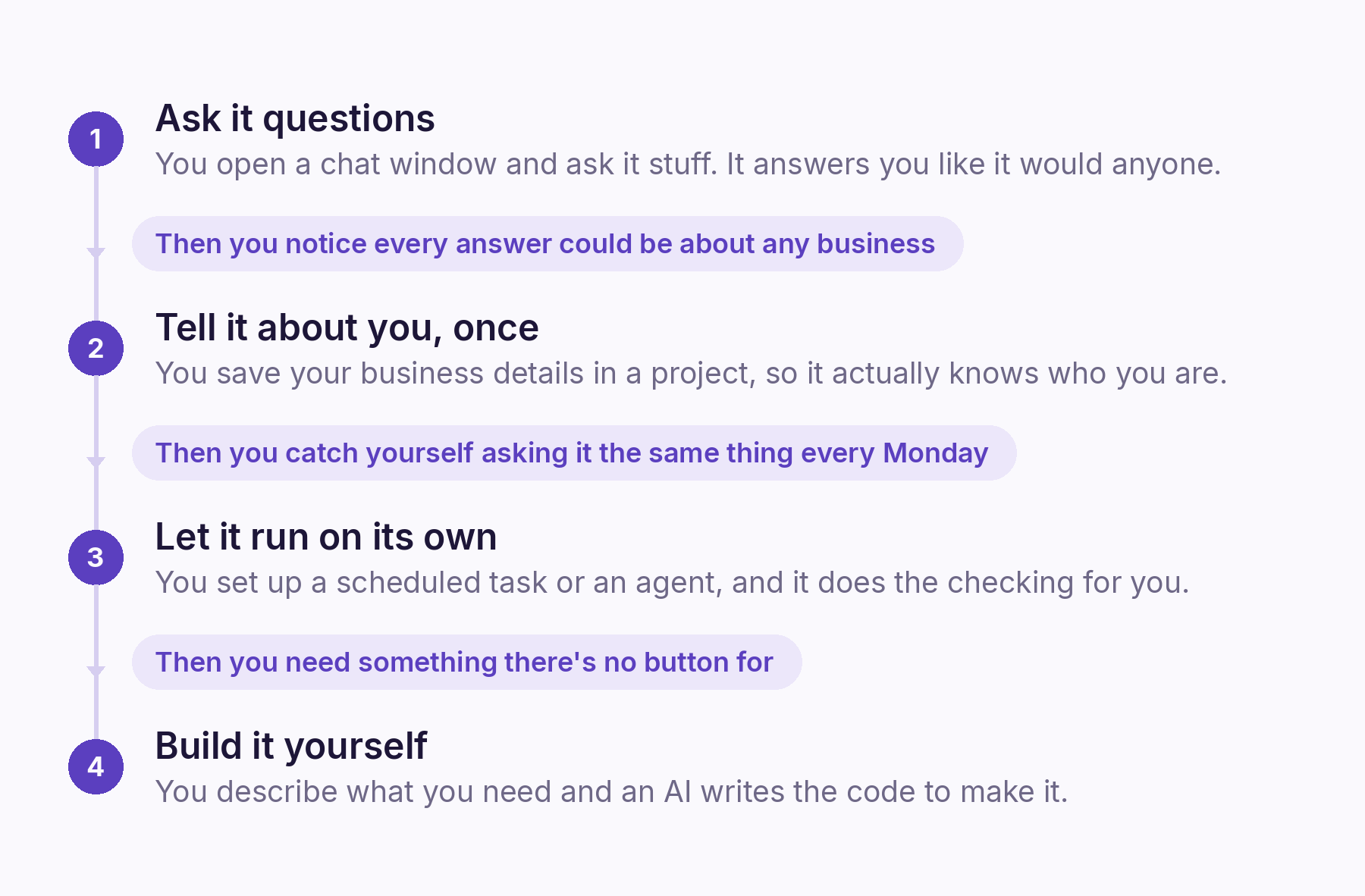
Every step I've taken happened because I was trying to solve a problem. I never sat down to learn a new tool. I had something I needed done, and the tool I was using couldn't do it the way I wanted it to.
Figuring out what to build took months. Building it took a weekend.
If you stay on top of your problem then moving to the next step takes care of itself.
You can solve real problems at every one of these steps. A chat window is enough for a lot of people, and it stays enough for a long time. Not every step is for everybody, and that's fine.
Skipping ahead costs you, though. I tried to jump straight to building and spent months forcing something I didn't understand. That was learning I would have picked up on the way if I would not have skipped steps.
But I'd still push you to try the next one. Even as a shot in the dark. Take the thing that's bugging you one step further than you normally would, and ask the AI to explain what it's doing while it does it. It will teach you if you ask.
Find yourself on the map above and read the line under your step. If you've felt that, you already know what's next. Below is one thing to try for each step.

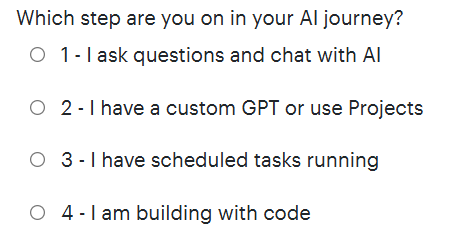
P.S. We are always looking to hear about our readers’ experience with AI. If you have brief moment, we’d love to know where you are at. This helps us know what to share.
CNBC and SurveyMonkey asked US workers how they actually use AI on the job. Of the people who use it at all, only 6% go to AI first when they hit a task. Most try to work it out themselves before asking, and three in ten don't use it for problem-solving at all. Over half of workplaces have no policy on it either way.
Our Take: Being at step one is where nearly everybody is. The one thing to try this week takes two minutes. Ask it something only somebody who knew your business could answer. When the answer comes back generic, don't rewrite the question. Tell it what it got wrong, in plain English, and ask again. The second answer is the one you were looking for, and that's the difference between step one and step two.
Source: CNBC and SurveyMonkey, Q3 2026
Whatever tool you use has a place to save things it should always know. In ChatGPT it's a project or custom instructions. In Claude it's a project. Ten minutes there is the biggest jump in answer quality you'll get for the least work.
Put these five in, in your own words:
- What you sell and to whom.
- How many locations, and where.
- What a good month looks like, and what a bad one looks like.
- The one problem you're working on right now.
- How you want it to talk to you. Short, plain, no fluff.
If you want the walkthrough for your specific tool or the version for a whole team, check these out: Stop re-explaining yourself to AI and Give your whole team the same context
If you caught yourself asking the same question every Monday, that question is your first scheduled task. Don't invent a new one, just go with the one you already ask.
Then follow one rule when you write it: one specific thing, from one specific place, and only tell me what changed. "Check our competitor's pricing page every Monday and tell me what's different from last week" works. "Keep me updated on the industry" doesn't, because there's nothing for it to check.
If you'd rather have the instructions written for you, use this tool:
Build your first scheduled task →A study of how professional developers use AI coding tools found none of them hand over control completely. Even the ones who call it vibe coding still read the output. The researchers name the risk for non-programmers directly: running code you can't evaluate, in a situation where being wrong costs something.
Our take: There's a real debate about vibe coding right now, and nobody has settled it. This is the step where everyone is still figuring things out, including us. What we can see is that people who started by just describing what they wanted are picking up more about how software actually works, not because they set out to, but because they had to read what came back.
Source: Professional Software Developers Don't Vibe, They Control. arXiv, 2025
We'd love to see what you're building. Reply and show us!

— Brian, Murphy, John, Beth, and Jake. Some of the humans behind AI Front Desk.
Your team can't be everywhere. Your AI can.
Every missed lead, unanswered inquiry, and unsaved cancellation is revenue walking out the door. AI Front Desk works alongside your team to make sure the work gets done - every lead, every hour, every day.