Ask ten operators whether customers should be told they are talking to AI and you get ten answers. We wanted data to back up ours.
So we measured it. Across every location in one franchise group, we compared how conversations go when the booking agent introduces itself as the studio's digital assistant against how they go when it does not.
Before we looked, we wrote down the three numbers we would watch: opt-outs, replies, and how often the agent hands a conversation to a human.
Opt-outs and replies barely moved. The third one did.
An escalation is when the agent decides a conversation needs a person and hands it over. When the agent says up front that it is AI, escalations run 28% lower.
That count includes every handoff, not only the ones where somebody asked for a human. For example, someone tries to make two bookings at once, asks a billing question, or wants something the agent was never set up to finish. Handoffs like those happen at the same rate either way, so part of that baseline was never going to move, which makes the difference bigger than it looks.
We expected telling people it was AI would push more conversations to a person, and it does the opposite.
What we think happens is that knowing changes how somebody talks to it. If you are not sure who is on the other end, you hedge. You ask a small question first and wait to see what comes back. Once it says it is the studio's assistant, you stop working out who you are talking to and just ask for what you came for, because an assistant is obviously there to book you in.
People are not put off by it being AI. They use it for what it is, and more of those conversations finish without anybody stepping in.
Our client's staff noticed this more than the leads have. When a conversation goes wrong, nobody assumes an employee handled it badly, and they have told us that takes the pressure off.
So, should you tell your customers? Right now our data says yes. It does not cost you their patience. It gets you somebody who knows what to ask for.

Go to your own website after dinner and fill in the enquiry form like a customer would.
Use a phone number nobody at your locations recognises.
Then watch the clock.
How long until something comes back? Is it useful, or is it "thanks, we'll be in touch"? If you reply to it, does anything happen?
Most operators have never done this and are surprised by what they find. Ten minutes, and you will know exactly where you are losing people.
A researcher at MIT went through more than 15,000 leads and 100,000 call attempts to find out how much response time actually matters. Contact somebody within five minutes and you are about a hundred times more likely to reach them at all, and twenty-one times more likely to qualify them, than if you wait thirty. Not thirty hours. Thirty minutes. That was 2007, and every study since has landed in the same place.
Our Take: Most operators are not losing leads to a competitor with better pricing. They are losing them to whoever answered first. Look at the gap between when your last ten enquiries came in and when somebody replied. If those gaps are measured in hours, that is what is costing you bookings, and it has nothing to do with your offer.
Everything above is what we would act on this week. Below is what made headlines, and what it actually means for you.
Astra landed on September 3. OpenAI's president called it the AGI era. It is the first model the company has rated Critical for cyber capability under its own safety framework, and it uses a reasoning technique that makes it harder for researchers to audit how it reached an answer, which several of them have said out loud is a problem.
Our Take: You do not need to do anything about this. A better model does not answer your leads faster or fill your Tuesday morning classes. When somebody tells you a new model changes everything, the question to ask is which of your problems it solves, and if they cannot name one in a sentence, it does not solve any of yours yet.
…but it seems pretty cool so we are definitely going to try it out.
Source: TechCrunch
Two weeks ago we pointed you at Claude Cowork for setting up a scheduled task. Last week we listed Custom GPTs as a place to save what your AI should know about your business. Since then, both have moved.
OpenAI published a retirement timeline for Custom GPTs. No new ones after September 25, and existing ones stop running on December 11. Projects are the replacement and already do the same job.
Anthropic announced today that Cowork is being folded into ordinary Claude chat, so there is no separate place to go. Nothing you built there breaks, and the thing that confused people, working out which tab a task belonged in, is gone.
Our Take: One got switched off and one got simple. Keep your own copy of whatever you wrote. The instructions you write about your business are worth something, and they are the part that survived both of these. The place you happened to keep them is a rental. Write it down somewhere you own, then paste it into whatever the tool is called next year.
Source: OpenAI Help Center, TechCrunch
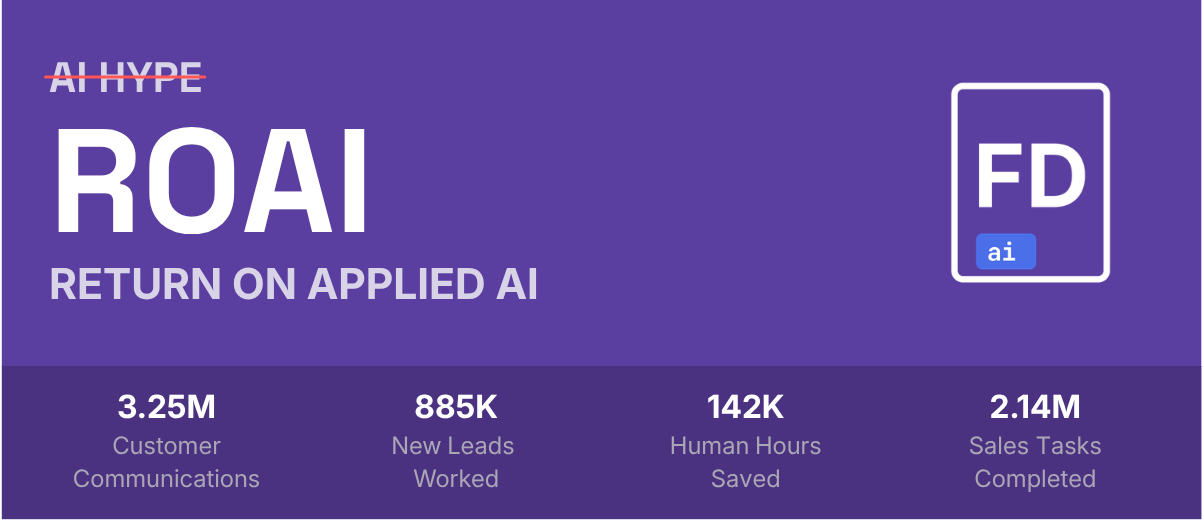
There continues to be a TON of AI Hype out there. To avoid the hype and stay focused on outcomes, we ask ourselves “Does the thing actually do the thing?”
If you aren’t seeing ROI from your AI, let’s chat.

— Brian, Murphy, John, Beth, and Jake. Some of the humans behind AI Front Desk.