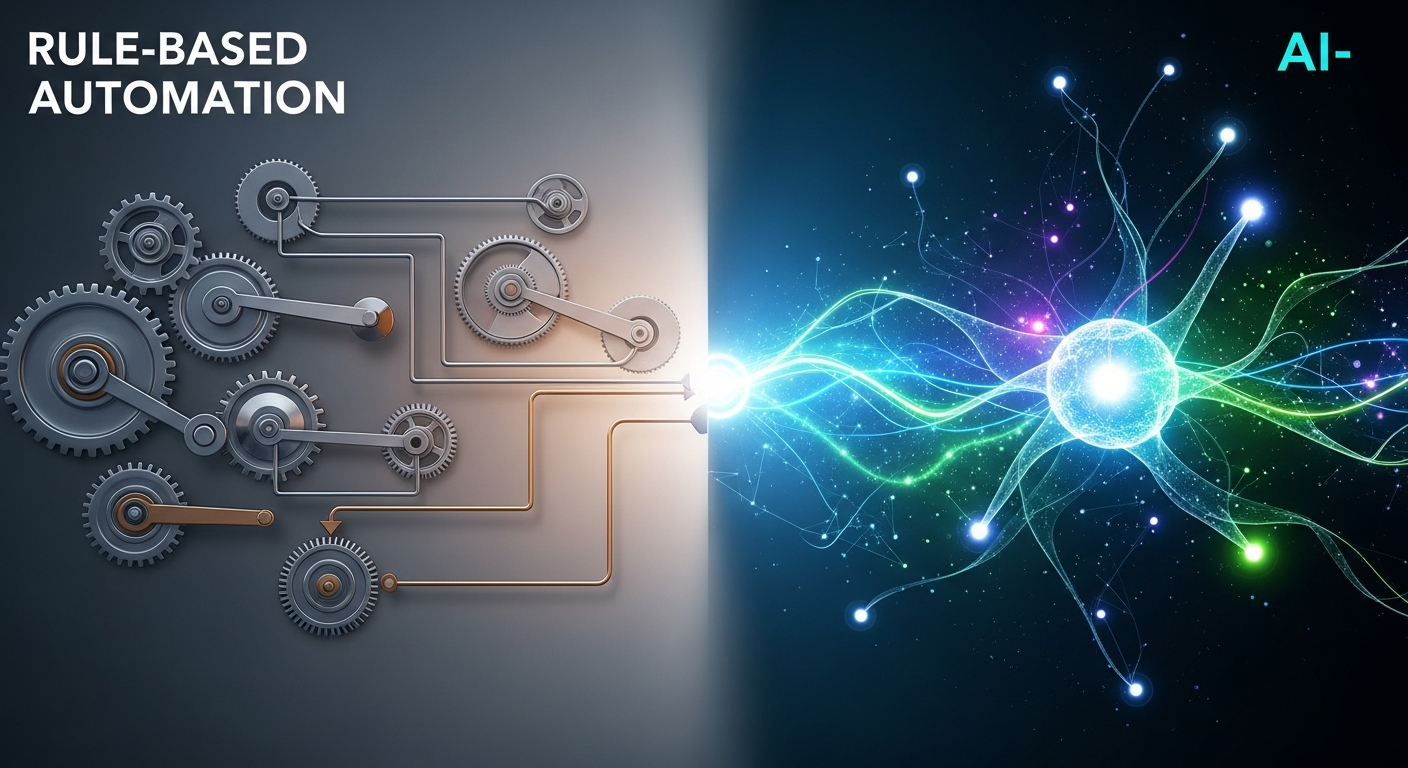
The landscape of multi-location service businesses, from bustling fitness studios to meticulous dental practices and compassionate veterinary clinics, demands operational efficiency and consistent customer engagement. As these businesses scale, managing lead outreach, appointment scheduling, and member communications across various sites becomes increasingly complex. This article delves into the fundamental differences between rule-based and AI-powered automation, offering multi-location operators a diagnostic framework to assess which approach best aligns with their operational needs and strategic goals. Understanding these distinctions is crucial for enhancing efficiency, improving customer experience, and empowering staff.
Effective automation is not just about doing things faster; it's about doing the right things smarter, consistently, and at scale across every location.
Understanding Rule-Based Automation
Rule-based automation, often considered the foundational layer of automated processes, operates on a predefined set of instructions. It's characterized by "if this, then that" logic, where specific conditions trigger specific actions. There's no learning or adaptability beyond what is explicitly programmed.
How It Works
Imagine a flowchart: each step is a decision point or an action, and the path is determined by simple, clear rules.
- Trigger: An event occurs (e.g., a new lead submits a form).
- Condition: A rule is met (e.g., "if lead source is 'website inquiry'").
- Action: A predefined task is executed (e.g., "send welcome email A").
Common Applications in Multi-Location Services
- Basic Auto-Responders: Sending an immediate "thank you for your inquiry" email after a web form submission.
- Standard Appointment Confirmations: Automatically sending a confirmation email or SMS 24 hours before a scheduled appointment.
- Simple Lead Routing: Directing leads to a specific location or sales agent based on geographic zip codes or service interest.
- Tiered Membership Welcome Series: A sequence of emails sent to new members over a set period, introducing benefits and resources.
- Automated Billing Reminders: Sending alerts for upcoming payment due dates or overdue invoices.
Strengths of Rule-Based Automation
- Predictability: Outcomes are always consistent given the same inputs, making it easy to audit and troubleshoot.
- Simplicity: Often straightforward to set up for basic, repetitive tasks without complex coding.
- Transparency: The logic is clear and easily understood by anyone reviewing the rules.
- Cost-Effective for Static Workflows: Lower initial investment for well-defined, unchanging processes.
- Reliability: Performs exactly as programmed without deviation.
Limitations of Rule-Based Automation
- Lack of Adaptability: Cannot handle unforeseen scenarios, ambiguous inputs, or changes in customer intent.
- Scalability Challenges with Complexity: As processes become more intricate, the number of rules can become unmanageable and difficult to maintain.
- Inability to Learn: Does not improve over time or adapt to new data. Requires manual updates for any process changes.
- Limited Personalization: Interactions often feel generic and impersonal, as they can't dynamically adjust based on individual customer context beyond basic data points.
- Struggles with Natural Language: Cannot interpret nuanced human language, making it ineffective for open-ended queries.
Understanding AI-Powered Automation
AI-powered automation goes beyond fixed rules by leveraging artificial intelligence, including machine learning (ML) and natural language processing (NLP), to understand, learn, and adapt. It can interpret complex inputs, make intelligent decisions, and personalize interactions based on data.
How It Works
Instead of just "if X, then Y," AI automation uses algorithms to analyze vast amounts of data, recognize patterns, and predict optimal actions.
- Data Ingestion: Gathers and processes various data points (customer history, communication logs, behavior patterns).
- Analysis & Learning: ML algorithms identify trends, sentiments, and intent from the data.
- Decision & Action: Based on its learning, the AI determines the most appropriate response or action, even for novel situations.
- Continuous Improvement: The AI continuously refines its understanding and decision-making capabilities as it processes more data.
Common Applications in Multi-Location Services
- Intelligent Lead Nurturing: AI analyzes lead behavior and engagement data to send personalized content and offers at optimal times, increasing conversion potential.
- Dynamic Appointment Booking: AI chatbots interact with prospects and members using natural language, understanding their preferences and scheduling appointments in real-time, even handling complex requests like rescheduling or finding alternative slots.
- Personalized Member Retention Communications: AI can identify members at risk of churn based on activity patterns and engagement levels, triggering proactive, personalized communications to re-engage them.
- Win-Back Campaigns: AI analyzes past member data to tailor specific offers and messaging for lapsed members, increasing the likelihood of their return.
- Sentiment Analysis: Monitoring incoming communications to gauge customer satisfaction or identify potential issues, allowing for proactive intervention.
- FAQs and Support Chatbots: AI-driven chatbots can answer a wide range of customer questions with human-like responses, escalating to staff only when necessary.
Strengths of AI-Powered Automation
- Adaptability & Flexibility: Can handle complex, ambiguous, and novel situations, adapting to new information and evolving customer needs.
- Continuous Learning: Improves performance over time as it processes more data, leading to more accurate and effective outcomes.
- Enhanced Personalization: Delivers highly relevant and individualized experiences, making interactions feel more human and less robotic.
- Scalability for Complexity: Manages a vast array of scenarios and interactions without requiring an exponential increase in programmed rules.
- Predictive Capabilities: Can anticipate future needs or behaviors, enabling proactive outreach and service.
- Natural Language Understanding: Interprets human language, allowing for more intuitive and conversational interactions.
Limitations of AI-Powered Automation
- Data Dependency: Requires substantial, high-quality data for effective training and operation. Poor data leads to poor performance.
- Initial Setup Complexity: Can be more involved to configure and fine-tune, requiring expertise in AI/ML principles.
- "Black Box" Effect: The decision-making process of advanced AI can sometimes be opaque, making it challenging to understand why a particular action was taken.
- Ongoing Monitoring & Refinement: While self-improving, still requires human oversight to ensure ethical behavior, accuracy, and alignment with business goals.
- Cost: Often involves a higher initial investment and potentially ongoing costs for maintenance and data processing.
The Core Differences: A Comparative Framework
To aid multi-location operators in their decision-making, here's a comparative overview of rule-based and AI-powered automation:
| Feature | Rule-Based Automation | AI-Powered Automation |
|---|---|---|
| Foundation | Predefined 'if/then' logic, fixed rules | Machine learning, natural language processing, data analysis |
| Learning Capability | None; static and unchanging | Learns and improves over time from data |
| Adaptability | Low; struggles with ambiguity and new scenarios | High; adapts to new information and evolving contexts |
| Personalization | Limited; based on simple data points | High; dynamic, context-aware, and individualized |
| Complexity Handled | Simple, repetitive, predictable tasks | Complex, dynamic, and nuanced interactions |
| Required Data | Minimal; only for rule conditions | Significant, high-quality data for training and operation |
| Maintenance | Manual updates for any process changes | Continuous learning, but requires oversight for refinement |
| Customer Experience | Consistent but can feel generic | Highly engaging, empathetic, and human-like |
| Best Use Cases | Basic notifications, simple routing, fixed sequences | Lead nurturing, dynamic scheduling, retention campaigns, complex FAQs |
Choosing the Right Automation for Your Multi-Location Business: A Decision Matrix
Selecting the appropriate automation strategy involves a diagnostic self-assessment. Consider these factors to align technology with your specific multi-location operational demands.
Step 1: Identify Your Core Operational Bottlenecks
List the top 3-5 recurring challenges across your locations that consume significant staff time or negatively impact customer experience.
- Example: High volume of missed calls for bookings, inconsistent lead follow-up, staff burnout from repetitive inquiries, high no-show rates.
Step 2: Assess the Nature of Your Communications
Categorize the types of interactions you frequently handle.
Communication Complexity Assessment:

1.  **Simple & Repetitive:**
    *   Examples: Appointment confirmations, basic 'open/close hours' questions, payment reminders, generic welcome messages.
    *   **Best Fit:** Rule-Based Automation

2.  **Moderate & Varied:**
    *   Examples: Rescheduling requests, specific service inquiries (e.g., "Do you offer prenatal yoga?"), membership upgrade questions, lead qualification.
    *   **Best Fit:** Hybrid (Rule-Based for initial triage, AI-Powered for deeper interaction) or AI-Powered.

3.  **Complex & Nuanced:**
    *   Examples: Resolving service complaints, personalized upsell opportunities, detailed health inquiries (dental/vet), win-back conversations, sentiment-driven retention outreach.
    *   **Best Fit:** AI-Powered Automation
Step 3: Evaluate Your Data Landscape
- Do you have access to clean, structured data on customer interactions, preferences, behaviors, and historical outcomes across all locations?
- Yes: AI-powered automation can leverage this data effectively.
- No/Limited: Rule-based might be a more practical starting point, or prioritize data collection for future AI implementation.
Step 4: Define Your Desired Customer Experience
- Is consistency paramount, even if it's generic? Rule-based provides uniform responses.
- Do you aim for highly personalized, empathetic, and adaptable interactions? AI-powered solutions excel here, fostering deeper connections and reducing friction.
- Are you looking to free up staff for high-value human interactions? AI can handle the routine, allowing staff to focus on complex or sensitive cases.
Step 5: Consider Scalability and Future Growth
- Are your needs static, or do you anticipate evolving services, new locations, and increasing customer interaction volume? AI-powered automation is inherently more scalable for complex, dynamic growth. A platform like AI Front Desk, designed for multi-location businesses, offers centralized control and consistent AI deployment across all sites, ensuring brand voice and service quality remain uniform as you expand.
Decision Framework:
| Criteria / Priority | Primarily Rule-Based Automation | Primarily AI-Powered Automation |
|---|---|---|
| Core Need | Automate simple, high-volume, predictable tasks | Personalize interactions, handle complex queries, drive dynamic outcomes |
| Interaction Type | Transactional, informational, fixed responses | Conversational, problem-solving, intent-driven |
| Data Availability | Low to moderate; clear rules are primary | High; rich historical and real-time data is essential |
| Desired CX | Efficient, consistent, but potentially impersonal | Empathetic, personalized, proactive, intelligent |
| Staff Empowerment Goal | Reduce basic administrative burden | Free up staff for high-value, complex, human-centric tasks |
| Scalability Focus | Scaling volume of simple tasks | Scaling complexity and personalization of interactions |
Implementing Automation in a Multi-Location Context
Regardless of the type of automation chosen, multi-location businesses face unique challenges in implementation:
- Ensuring Brand Consistency: Every automated message, whether rule-based or AI-driven, must align with your brand voice and service standards across all locations. A centralized platform, like AI Front Desk, is instrumental here, allowing for global content management and localized adjustments where necessary.
- Integration with Existing Systems: Automation tools must seamlessly integrate with your scheduling, CRM, and POS systems to avoid data silos and ensure smooth workflows.
- Staff Training and Adoption: Staff at each location need to understand how the automation works, how to leverage its benefits, and when human intervention is required. This often involves clear guidelines and ongoing support.
- Centralized Monitoring and Optimization: A holistic view of automation performance across all locations is vital. This enables identification of common issues, successful strategies, and areas for improvement, ensuring all sites benefit from continuous optimization.
For multi-location service businesses, AI-powered automation offers a strategic advantage by managing the nuances of customer engagement and operational workflows, allowing staff to focus on delivering exceptional in-person service.
Common Pitfalls to Avoid
Implementing automation, especially AI-powered solutions, requires careful consideration to prevent missteps that could undermine its benefits.
- Over-Automating Sensitive Interactions: Not every customer interaction is suitable for full automation. Some queries, particularly those involving personal health details, urgent issues, or complaints, benefit from immediate human empathy and judgment. Striking the right balance is key.
- Neglecting Human Oversight: Even the most advanced AI needs human supervision. Regular monitoring of AI performance, reviewing flagged interactions, and providing feedback helps the system learn and ensures it operates within ethical and business guidelines.
- Poor Data Quality: For AI to be effective, it needs clean, relevant, and sufficient data. Inaccurate or incomplete data across locations can lead to flawed decision-making, ineffective personalization, and a frustrating customer experience.
- Failing to Define Clear Objectives: Before deploying any automation, clearly articulate what you aim to achieve (e.g., reduce call volume by X%, improve lead conversion by Y%, increase member retention). Without clear goals, measuring success and optimizing the system becomes impossible.
- Ignoring Staff Feedback: Front-line staff are invaluable sources of information about customer interactions and operational bottlenecks. Involve them in the design and implementation process, and solicit their feedback regularly to refine automation strategies.
- Choosing Technology That Doesn't Scale: Opting for a solution that works for one location but cannot handle the complexity or volume of a multi-location enterprise can lead to costly re-platforming down the line. Select platforms designed with scalability in mind from the outset.
Quick Wins for Multi-Location Operators
To begin leveraging automation effectively, consider these immediate, actionable steps:
- Conduct a Communication Audit: Map out all customer touchpoints and current communication methods across 2-3 of your locations. Identify which communications are repetitive, consistent across sites, and frequently consume staff time. This highlights prime candidates for automation.
- Pilot Basic Rule-Based Automation: Choose one simple, high-volume task, like sending appointment reminders or post-visit follow-ups, and implement a basic rule-based automation. Start with one location as a pilot, then expand.
- Identify a "High-Value, Low-Complexity" AI Opportunity: Think about tasks where personalized, immediate responses would significantly improve customer experience or lead conversion, but don't involve highly sensitive data. Examples include automating initial lead qualification or providing instant answers to common FAQs via an AI chatbot on your website.
- Standardize Data Collection: Begin efforts to standardize how customer data, communication logs, and appointment information are recorded across all locations. This lays the groundwork for more sophisticated AI-powered solutions in the future.
- Educate Your Team: Host a brief workshop for your staff on the concept of automation, explaining its benefits (less repetitive work, more focus on customers) and how it will free them to excel in their roles. Address concerns and gather initial input.
Strategic implementation of automation, whether rule-based or AI-powered, transforms operational efficiency and customer engagement, empowering your multi-location business to thrive.
Conclusion
The distinction between rule-based and AI-powered automation is not about choosing one over the other in all cases, but rather understanding their unique strengths and applying them strategically. Rule-based automation excels at predictable, high-volume, and simple tasks, offering reliable consistency. AI-powered automation, however, offers unparalleled adaptability, personalization, and intelligence, transforming complex customer interactions and optimizing operational workflows for multi-location service businesses.
For operators aiming to centralize communications, provide consistent service across all locations, automate lead nurturing and booking, and empower their staff to focus on in-person service, AI-powered platforms like AI Front Desk offer a comprehensive solution. By carefully assessing your operational bottlenecks, communication complexity, and desired customer experience, you can strategically implement the right automation to drive efficiency, enhance engagement, and position your multi-location business for sustained growth.